Why Elite Soccer Officiating is Harder Than Ever: The Psychological Mix
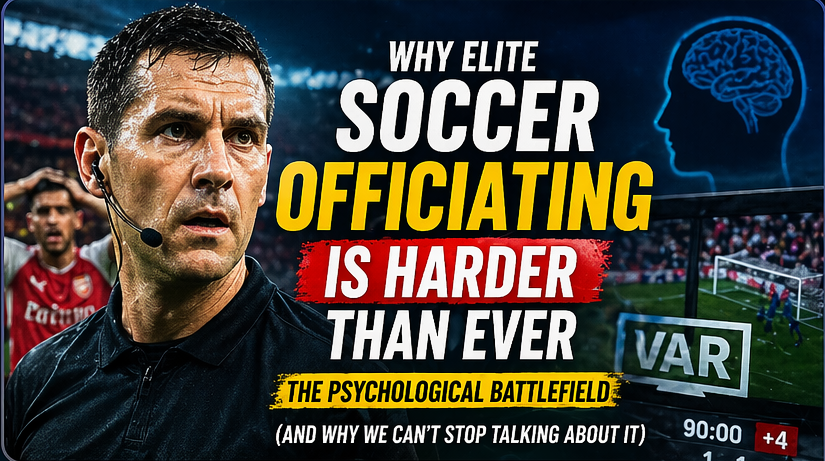
Why Elite Soccer Officiating is Harder Than Ever: The Psychological Battlefield. (And Why We Can’t Stop Talking About It)
Discover the mental architecture of elite soccer referees. From VAR stress to decision fatigue, learn why soccer officiating is a psychological survival game in 2026.
What is elite soccer officiating?
The roar of 80,000 voices is not just a sound; it is a physical weight. For an elite soccer referee in 2026, standing in the center of a stadium like the Santiago Bernabéu or the Emirates, the air is thick with more than just noise.
It is charged with the expectations of billion-dollar industries, the tribal fury of fanbases, and the cold, unblinking eyes of thirty high-definition cameras. If you are an Arsenal fan, you probably spent last weekend screaming at your television, convinced that the person in the middle was out to get you.
But have you ever stopped to wonder what is actually happening inside their brain when they make—or miss—that game-changing call?
In the wake of recent high-profile VAR (Video Assistant Referee) failures and high-stakes controversies that have seen officiating standards questioned at the highest levels of the Premier League and UEFA, the focus has shifted.
It is no longer just about knowing the FIFA RULES inside and out. It is about the psychology of survival. This deep dive explores the mental architecture required to excel in elite soccer officiating.
Also, get the “split-second” cognitive processes under fire, and how the introduction of technology has paradoxically made the mental burden heavier than ever before.
If you’ve ever thought you could do a better job from your couch, it’s time to look under the hood of the most stressful job in sports.
I. The Anatomy of a Split-Second: The “90+4” Minute Decision In Soccer Officiating
Imagine a late-season title decider. The score is 1-1. In the 94th minute, a striker tumbles in the box. To the naked eye, it’s a clip of the ankle. To the defender, it’s a blatant dive. To the referee, it’s a decision that must be made in approximately 200 milliseconds.
This is where soccer officiating becomes less of a sport and more of a high-stakes cognitive experiment.
Feature Detection: This is the first hurdle. A referee’s brain must perform a task faster than a professional sprinter reacts to a starting pistol.
They must filter out “attentional noise”—the screaming players, the waving arms, the tactical fouling—and focus solely on the point of contact. This requires a level of sensory gating that most humans simply do not possess.
The Cognitive Load: Elite referees operate under a state of constant Hyper-Vigilance. Studies in sports psychology suggest that a referee makes between 200 and 250 visible decisions per match.
However, they make thousands of “non-decisions”—the conscious choice not to whistle—which are equally taxing on cognitive reserves. For fans looking to improve their own, visit comprehensive match analysis tools like https://karizsoccer.soccersolved.com/. Esssentially, understanding this load is the first step toward seeing the game like a pro.
Decision Fatigue: As the match reaches the final minutes, the brain’s glucose levels drop. The prefrontal cortex, responsible for complex logic and impulse control, begins to struggle. This is the “Danger Zone” where most controversies are born.
When we see a referee miss a clear foul in stoppage time, it often isn’t a lack of knowledge; it’s a physiological system running on empty.

Image generated for: “A high-contrast close-up of a soccer referee’s eyes, reflecting the bright stadium lights and a blurred crowd, symbolizing intense focus and cognitive pressure.”
II. The VAR Paradox: Technology as a Psychological Stressor In Soccer Officiating
The introduction of VAR was intended to be a “safety net,” a way to ensure the FIFA RULES were applied with clinical precision. Instead, for the referee on the pitch, it has become a “Psychological Tightrope.”
The Erosion of Intuition: Before VAR, a referee relied on Heuristics. These are mental shortcuts built over decades of experience. If a tackle “felt” wrong, it usually was. Now, referees are coached to “delay the whistle.”
This goes against every instinct they have honed since they were teenagers officiating Sunday league matches. Psychologically, this creates Cognitive Dissonance.
The referee’s gut tells them one thing, but the protocol demands they wait for a digital confirmation. This hesitation can be felt by the players, often leading to a loss of authority on the pitch.
Social Loafing: There is a psychological phenomenon where individuals put in less effort when they know they are part of a group with a safety net.
In officiating, there is a constant risk that the on-field official becomes less decisive, subconsciously leaning on the “backup” of the VAR room. This leads to the “clear and obvious” debate that plagues the Premier League.
The Spotlight Effect: When a referee is called to the pitch-side monitor (the RRA—Referee Review Area), they aren’t just looking at a screen; they are entering a Public Performance Trial in soccer officiating.
They know that every blink and facial twitch is being broadcast to millions. The pressure to agree with the VAR’s suggestion is immense, leading to Confirmation Bias.
They aren’t looking for the truth; they are looking for the evidence that supports the VAR’s intervention.
III. Dealing with “The Aftermath”: The Anatomy of a Controversy In soccer officiating
When an officiating error goes viral—especially one involving a club with a massive digital presence like Arsenal—the psychology shifts from “In-Game Performance” to “Post-Traumatic Resilience.”
The Echo Chamber of Social Media: In 2026, a referee doesn’t just leave the pitch; they enter a digital battlefield. The “dehumanization” of officials on social platforms creates a unique form of occupational stress.
Elite referees now undergo Cyber-Resilience Training, learning to detach their self-worth from the public discourse. The psychological danger here is Ruminative Thinking.
This is where an official replays a mistake thousands of times, leading to a loss of confidence in the next match.
For those mastering the mental side of football, you can use https://karizsoccer.soccersolved.com/ among others tools, to help overcoming this cycle since its the difference between a career and a breakdown.
The Narrative of “The Agenda”: One of the most difficult psychological hurdles for modern referees is the rise of conspiracy theories.
When managers imply “bias” or “agendas,” it attacks the core of the referee’s professional identity: Neutrality.
This can lead to Over-Compensation. Subconsciously, a referee might make a harsh call against a team in the next game just to prove they aren’t biased in their favor.
It’s a vicious cycle that undermines the integrity of the whistle.

Image generated for: “A split-screen graphic: on one side, a referee stands alone in a dark tunnel; on the other, a chaotic mosaic of social media angry-face emojis and blurred sports headlines.”
IV. The Elite Mindset: Training the “Inner Official” In soccer officiating
How do the world’s best officials stay sane? The answer lies in elite mental conditioning that mirrors that of Special Forces or trauma surgeons.
They aren’t just referees; they are high-performance athletes who specialize in advanced soccer training programs designed for the mind.
Box Breathing and Physiological Regulation: When a controversy erupts—players surrounding the ref, the crowd baying for blood—the referee’s sympathetic nervous system triggers a “Fight or Flight” response.
Their heart rate can spike to 180 BPM. To combat this, officials use Vagus Nerve Stimulation through specific breathing patterns.
By manually lowering their heart rate, they allow the rational brain (the prefrontal cortex) to stay in control, preventing an emotional reaction to a player’s dissent.
Visualization and Pre-Mortems: Elite referees engage in “Pre-Mortem” exercises. They visualize the worst-case scenario: a missed red card in the first minute, a VAR failure, or a pitch invader.
The soccer officials experience the stress in a controlled mental environment, which makes the actual event lose its power to paralyze them. They have already “lived” the failure, so they know how to navigate the recovery.
Self-Talk and Anchoring: Referees use specific verbal triggers to reset their focus after a controversial moment. If they realize they’ve made a mistake, they use an “Anchor” to stay in the present moment.
This prevents the “Snowball Effect,” where one error leads to a series of poor decisions throughout the match. Otherwise, to avaoid poor decisions, a soccer referee must be well versed with FIFA or IFAB Laws of the soccer game
V. The Arsenal Context: Why the Fans Feel the Burn From soccer officiating
For Arsenal fans, the relationship with soccer referees has often felt adversarial. From the infamous “Invincibles” streak ending at Old Trafford to modern-day VAR heartbreaks, the psychological toll on the fanbase is real.
Collective Victimhood: In psychology, a group can develop a sense of collective victimhood. When a fanbase feels consistently “wronged” by officials, they begin to view every neutral 50/50 call through a lens of persecution.
This isn’t just “sore losing”; it’s a documented psychological response to perceived injustice.
The Burden of the Technical Area during soccer officiating
:It’s not just the soccer fans. Football managers who exhibit high-intensity emotions in the technical area can actually influence the soccer referee’s Amigdala.
When a soccer manager is constantly aggressive, it can create a “hostile work environment” on the pitch, making the referee more likely to experience “Tunnel Vision” and miss subtle fouls elsewhere.

Image generated for: “A wide shot of a soccer stadium at night, with the referee a small, brightly lit figure in the center circle, surrounded by the dark, looming shadows of the stands.”
VI. The Future: AI and the Human Element
As we look toward the future of soccer officiating, “Semi-Automated” technology (like offside detection) is taking the “fact-based” decisions away from humans. This leaves the referee with only the most difficult, “subjective” decisions—foul play, intent, and handball.
Crisis Management: The psychology of the future Soccer officiating will be less about being a “judge of fact” and more about being a “Crisis Manager.”
Soccer officiating professionals must navigate the emotional temperature of the match, managing twenty-two high-adrenaline athletes while remaining a pillar of calm.
For those interested in developing a deeper understanding of the game, (https://karizsoccer.soccersolved.com/) will be a valuable addition.
In the end, watching how a referee de-escalates a confrontation is as important as watching the tactics of the wingers.
The Human Grace: To preserve the integrity of the game, the conversation must move away from “Correct vs. Incorrect” and toward “Human Capability vs. Technological Expectation.”
Referees are the only people on the pitch expected to be perfect, yet they are the only ones denied the grace of human error.
Understanding the mental toll of the whistle is the first step in de-escalating the toxic culture of controversy.
VII. Conclusion: The Mental Muscle Required in soccer officiating
The psychology of elite officiating is currently at a breaking point. The transition from a “gut-instinct” sport to a “pixel-perfect” industry has left the human element of the game in a state of constant stress.
Whether you are a die-hard Gooner or a neutral observer, it is worth remembering that the man or woman in the middle is not a robot. They are a high-performance athlete whose most important muscle is the one between their ears.
Soccer is a game of beauty and chaos. The referee’s job is to sit at the center of that chaos and, for 90 minutes, try to make sense of it—all while the world waits for them to fail.
That is the terrifying, exhilarating reality of the elite whistle. Next time a decision goes against your team, take a deep breath. The referee probably is, too.
FAQ: The Psychology of Soccer Officiating
Do soccer referees actually have a bias against certain teams?
While fans often feel there is a targeted agenda, sports psychology suggests that what we perceive as bias is usually a combination of crowd influence and confirmation bias.
Football referees are human and can be influenced by the atmosphere of a stadium, but professional officials undergo rigorous neutrality training to minimize these subconscious leanings.
How does VAR affect a referee’s confidence soccer officiating?
VAR can act as a double-edged sword. While it provides a safety net for “clear and obvious” errors, it can also lead to second-guessing.
The psychological term for this is cognitive dissonance in soccer officiating, where the referee’s immediate intuition is challenged by a slow-motion replay, often leading to a loss of confidence in their natural decision-making abilities.
What is “Decision Fatigue” in soccer officiating?
Decision fatigue is the decline in the quality of decisions made by an individual after a long period of decision-making. In a 90-minute match, a referee makes hundreds of choices.
As their physical and mental energy depletes toward the end of the game, the brain’s ability to process complex information slows down, which is why controversial calls often happen in the final minutes.
Can football referees hear the crowd?
Yes, and they are trained to manage it during their soccer officiating training. And while they cannot “tune out” 80,000 people, they use techniques like box breathing and focused self-talk to prevent the crowd’s noise from triggering a stress response.
They focus on “task-relevant cues”—the ball, the players’ feet, and the movement of the soccer game—rather than the auditory environment.
Why do referees rarely admit they were wrong?
In the high-stakes environment of elite sports, maintaining authority is crucial. Admitting a mistake mid-game can lead to a loss of player respect and a breakdown in match control.
However, modern officiating bodies have become more transparent post-match, often releasing audio or statements to explain the psychological and technical process behind difficult decisions.
So, what do you think? Are soccer referees and general football officiating affecting your soccer team?
You may also want TO READ “The Evolution of soccer dark arts: Why Haaland escaped punishment Hashtags
#SoccerOfficiating, #VAR, #SoccerReferees, #FootballAnalysis, #PremierLeague, #RefereePsychology, #VARControversy, #DecisionMaking, #Soccer2026, #FootballReferees, #SportsPsychology, #MatchAnalysis
blog soccer

How we make big money in arbitrage betting
Spread the loveHow we make money in arbitrage betting (sh..sh..sh..) “Hey there, soccer enthusiasts! Want to know the secret to making money from your love of the soccer game? Well, [...]
Euro Qualifying matches’ predictions, match day 9, November, 2023
Spread the loveEuro Qualifying matches’ Predictions (Match Day 9) in November 2023 Introduction: Discover the expert predictions for the Euro Qualifying matches in November 2023. Get accurate insights and analysis [...]
10 Rising Stars and Teams in Southeast Asian Soccer Fever
Spread the love10 Rising Stars and Teams in Southeast Asian Soccer Fever Meta Description Discover top soccer players and teams on the rise in Southeast Asian Soccer. Explore the stars, [...]
Mastering the Magic: Unleashing Your Inner Messi on the Field
Spread the love Lionel Messi, often hailed as one of the greatest footballers of all time, is renowned for his unparalleled skill, agility, and goal-scoring prowess. Watching Messi play is [...]
How to Become a Pro Soccer Analyst in 9 Steps and Earn Big
Spread the loveHow to Become a Pro Soccer Analyst in 9 Steps and Earn Big: A Step-by-Step Guide Meta Description: Discover how to become a professional soccer analyst with this [...]
Premier League Round 2 Round-up: Arsenal Sparkle As Manchester Clubs Stumble
Spread the lovePremier League Round 2 Round-up: Arsenal Sparkle As Manchester Clubs Stumble Here’s an in-depth analysis of the English Premier League matches played from last Friday, August 22nd, to [...]
“Next Messi? 10 Soccer Wonderkids Once Called So.
Spread the love“Next Messi? 10 Soccer Wonderkids Once Called So. Meta Description: Meet 10 soccer talents once called the next Messi. From Ødegaard to Januzaj, find out who became a [...]